Episode Transcript
[00:00:29] Tamara Dean: Welcome to the Terrain.org podcast, conversations with fascinating people who share Terrain.org's passion for place and focus on climate, community and justice. I'm the podcast editor, Tamara Dean.
Today I'm speaking with author Kubhushansingh Suryawanshi about his book The Ghost of the Mountains: Unraveling the Secrets of the Snow Leopard, which was published in August 2026 by Riverhead Books.
Kullu Suryawanshi is an ecologist and conservationist who has spent almost two decades studying snow leopards in the wild.
He's a fellow of the British Ecological Society, the Director of the India Program of the Snow Leopard Trust, and a scientist with the Nature Conservation Foundation.
The Ghost of the Mountains presents the amazing story of Kullu's decades of interacting with snow leopards in their mountain habitats.
The book weaves science and adventure with reflections on the role of this big cat in the human imagination through time and place.
Welcome, Kullu. I loved your book. I'm so happy to have you on the terrain.org podcast.
[00:01:40] Kullu Suryawanshi: Thank you so much for having me here, Tamara.
[00:01:42] Tamara Dean: Yeah, my pleasure entirely.
Your new book, the Ghost of the Mountains, brings the reader along with you as you track and study snow leopards in their habitat.
And it's so engaging on so many levels. But before we talk about your decades of research and what you discovered, can you describe what makes snow leopards different from other big cats and how they're uniquely suited to their habitat?
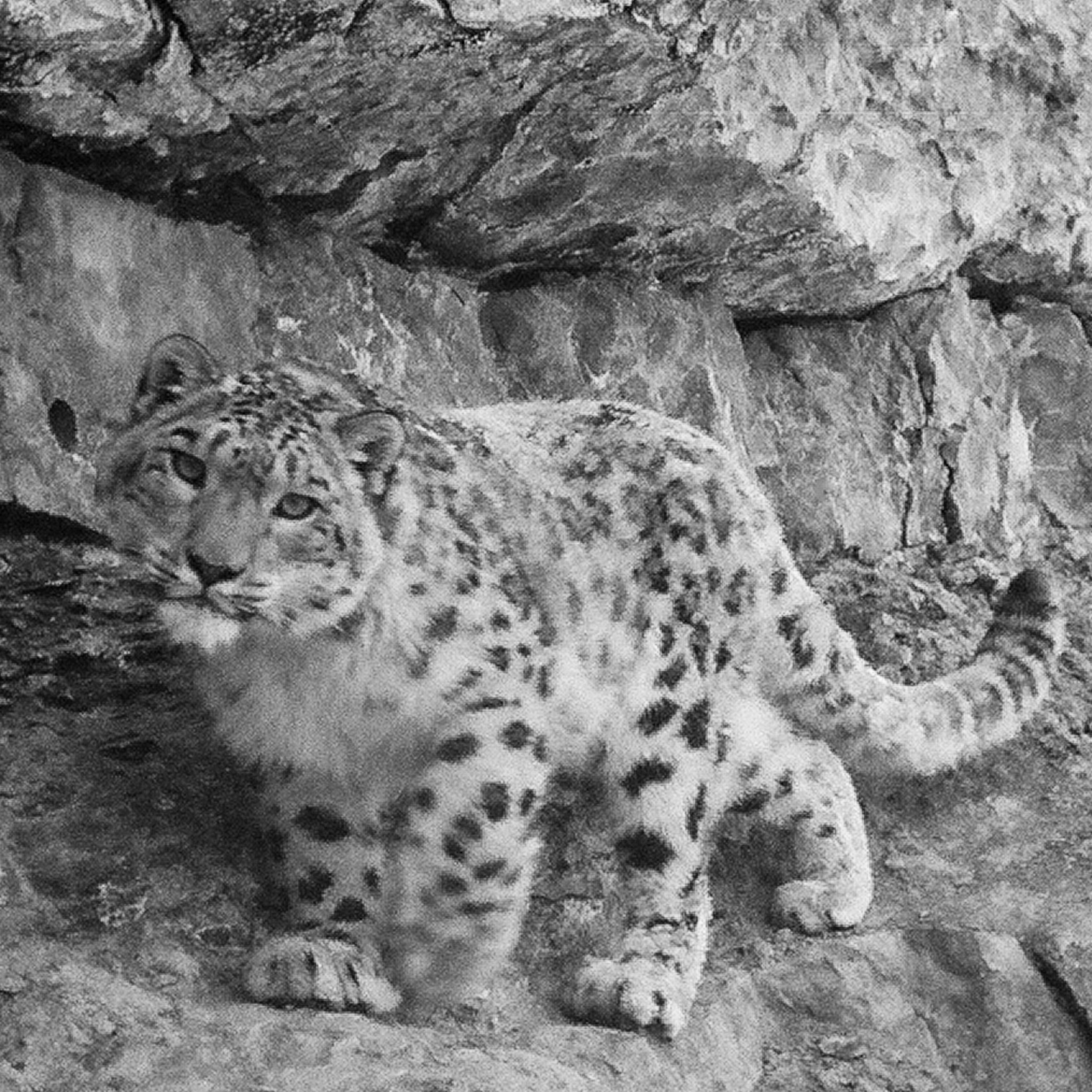
[00:02:07] Kullu Suryawanshi: Yeah, snow leopards are beautiful. They are the smallest of the five big cats that are around.
When I say smallest, they are still about 40 kilos, so they are a little larger than a big German shepherd dog.
They cannot roar like the tiger or the lion. They don't have the necessary vocal apparatus to do that, but they have a very mellow, meowing call.
Snow leopards are unique in that they are the only species on this planet, or they are the only carnivores on this planet that live only in the mountains and nowhere else. So if you think about the wolves, the wolves live in the mountains but also in the plains. So every other carnivore kind of has this dual home between the mountains and the plains. But snow leopards are the only carnivores that are obligate mountain dwellers, which means they ought to have the necessary adaptations to live there.
And they have many small adaptations. But some of the big ones are like, they have wider nasal cavity, which allows for the air as it goes into their lungs to warm in that nasal cavity before it enters the lung so that they don't inhale very cold air quickly.
Then they have these very wide, soft paws, which are almost like snowshoes so that they can walk on top of the snow.
They have this massive long tail. The tail is longer than the body itself, and it serves multiple purposes. One is the pole of a tightrope walker. It helps them balance on these steep cliffs, but also it acts as a muffler on a cold night. It's so long that when they sit, the tail can almost completely, you know, cover their body.
And then they have one of the thickest fur of any mammals on this planet. They have about 400 hairs per square inch, you know, compared to, say, 300 human hair on our head.
So really dense, thick fur that protects them not only from the cold, but also from the tough Himalayan landscape with craggy and sharp rocks.
They are cats. I believe they have nine lives because they have all these flexible joints and they have this flexibility about them that even when they fall off these big rocks and cliffs, they seem to be doing fine. I don't think they will be fine every time, but they are pretty good at taking those falls as well. So, yeah, it's a beautiful, small, big cat.
[00:04:44] Tamara Dean: And what got you fascinated in or interested in studying snow leopards? What was your inspiration when you were young?
[00:04:52] Kullu Suryawanshi: For me, actually, the inspiration were mountains. I was smitten by the mountains like many people do, especially in their youth. I wanted to go hiking, then wanted to go climbing, then wanted to become a mountaineer and climb the biggest mountains.
And this was the late 90s and early 2000s. Now, by that time, most big mountains in the Himalaya had been climbed, most big routes had been done.
And my mountaineering instructor kept saying that you have to find the mountain of your life that you want to climb. That's going to define you.
And while spending time in the mountains, I came across a snow leopard pugmark. And there was this moment of epiphany where I realized that the snow leopard was my mountain. I wanted to understand this almost mythical species because back then, so little was known about them that they became the mountain that I wanted to understand, that I wanted to spend the rest of my life pursuing.
That's how snow leopards happened.
[00:05:53] Tamara Dean: And you write in the book that initially you were met with resistance from your college professors to the idea of studying snow leopards. Can you tell me why your professors thought it wasn't a good idea?
[00:06:07] Kullu Suryawanshi: Yes, I think it was a well-intentioned pushback, because any college professor is worried about will my student have enough data to write a good thesis and make a good career in science, because science is all about making new findings.
Now, chasing the ghost of the mountains, they were pretty sure that I may not ever see one. And if I can't see one, how am I going to get enough data to write a good thesis and make scientific discoveries?
So I think the pushback came from that good intention.
But I was so driven that I had to find a way to get to the snow leopards.
[00:06:45] Tamara Dean: Yeah. So your very smart workaround was to study the snow leopard's prey, the blue sheep. Tell me more about that.
[00:06:53] Kullu Suryawanshi: Yes, absolutely.
So I could convince them that I was a trained mountaineer and that I could take on the big mountains, the fact that snow leopards are rare. I thought, let me start by studying their prey. And through the prey I can get some clues about snow leopard. So I started studying the winter foraging behavior of the blue sheep, which is one of the most important prey species of the snow leopard in the Himalaya.
While studying the blue sheep, within the first six months, I saw the snow leopard more than four, five times.
And I actually started getting a lot of data on snow leopards. And that is what helped me transition from studying snow leopard spray to snow leopards themselves.
[00:07:35] Tamara Dean: So you got what you wanted and you were successful. You studied snow leopards for decades. And that's where this book comes in. It's not only a summary of your research, but a travelogue of all the adventures along the way, some of which are just nail-biting and thrilling. I really enjoyed that.
Most listeners though, probably know snow leopards best from Peter Matthiessen's book The Snow Leopard.
And that created an idea in our imagination about snow leopards. But how has that idea changed since Matthiessen's quest in the 1970s?
[00:08:11] Kullu Suryawanshi: Yeah, the 1970s was a peculiar time of great transitions.
You know, I have to put Peter Matthiessen's work in context.
If you remember 1969, we had done the moon landing, and then in 1970s is the first photo of a wild snow leopard by Josh Schaller.
And so snow leopards became this bigger enigma here on planet Earth than the moon landing itself.
And Peter Matthiessen successfully wrote or created an imagination of the spiritual quest for the search within and for the search of snow leopards outside.
And he weaved a narrative about those two in the most brilliant way. It's a classic now.
However, over the years and two decades of living in this place, there are some things that came to me that felt like times have changed. One is that there are lots of people who live in this landscape. And when we are only looking inside ourselves and looking for the snow leopards, we tend to invisibilize these people. We tend to think of the mountains as Shangri La, the snow leopards living there, and us as the people with the soul, you know, the soul ability or interest to go on these spiritual quests.
I learned a lot not by pursuing the snow leopard alone, but by spending time with the herders who lived there, because they've lived there for centuries and there is so much of experiential knowledge that they have that I could benefit from. So for me, that was really a pivotal moment in moving away from the narrative that Peter had created to having a newer and a more grounded approach to thinking about the snow leopard.
[00:10:12] Tamara Dean: Right. And in The Ghost of the Mountains you write that snow leopards are rarely ever truly away from people.
Can you talk about how their proximity to human populations affected your research and also how it affects the snow leopards lives?
[00:10:28] Kullu Suryawanshi: Yeah, there are many fascinating things here.
One is snow leopards very often kill people's livestock. And one of the predominant threats, especially in the early 2000s, was livestock herders retaliating against snow leopards. So that's a challenge that existed because snow leopards lived in close proximity with people.
For me, there was a fundamental shift because I started living in the villages in these mountains and I would make the village my base for my research and that would help me glean a lot of knowledge, lot of information that was moving between herders every evening when they came back to the, to the village. And so that became a place to soak up all the going ons of the region in the valley and the place that is where I could talk my ideas out loud and get feedback from the herders, you know, whether something would work or not work, you know, what would be challenges, what is doable and what is not doable. Where can I push the envelope? So placing myself in the village as opposed to going on a lone quest, I was able to do a different kind of snow leopard research, I believe, which was not so much about a solo quest, but more about immersing myself into the human community that is already there in these places. And finally we know now that less than 10% of all the protected areas that are there in this landscape can house a viable population of snow leopards.
And so the reality is that if we have to conserve snow leopards, it will have to be done together with people.
[00:12:20] Tamara Dean: Yeah, you came up with a creative solution to the potential problem of snow leopards taking livestock from herders. Can you describe the collaboration that you were part of?
[00:12:31] Kullu Suryawanshi: The main thing was that I did not go after one solution. There was a journey of learning along the way. The first learning was that only increasing wild herbivore populations like the blue sheep was not going to solve the problem because if you have more blue sheep, you have more snow leopards and that means more livestock get killed.
Then came the idea that we need to protect livestock wherever they are, because we need the entire landscape for snow leopards to move through.
And so we started creating predator proof corrals with the local herders. We also had livestock insurance programs. And the whole point was we had to tackle this problem in multiple ways and create place based solutions. But the biggest epiphany or realization was actually when I surrendered my agency and started handing over money to herders so that they can find the solution that works best for them. And this transfer of agency from the conservationist to the person who's living with the snow leopards, to me was the most fruitful one because people would come with the most ingenious solutions.
The only thing they lacked was money and not imagination.
For me, that has been the biggest learning, conservation learning of my, of my journey.
[00:13:59] Tamara Dean: And I was particularly struck when you described how as researchers, you discovered that there wasn't as much animosity toward the snow leopards among her herders as you might have expected.
How has that realization informed your work with snow leopards and herders?
[00:14:15] Kullu Suryawanshi: Yeah, that's the central premise because we had very simple narratives that herders ought to hate snow leopards because snow leopards kill their livestock. And that's a very simplistic idea of a herder's life.
But a herder lives an equally sophisticated and equally complex life in the mountains. And there are moments when they don't like the snow leopards. There are moment when they even hate the snow leopards. But there are moments when they love the snow leopard and they also see not only aesthetic beauty in the animal, but sometimes even spiritual beauty in the animal. They also look up to the snow leopard as this being that is perfectly adapted to its home. So there are all these different relationships that herders have.
And when I would ask them, what should we do when snow leopards kill your livestock? The simple answer was very often, but snow leopards need to eat too.
And that simple answer helped me see that herders needed help with living with the snow leopard. So as long as they had help to cope with this animal. They wanted to be with this animal. Nobody ever said, we want all the snow leopards removed from here. Nobody ever said, take them away, take them out. Because they said, no, they're part of the system. We are part of the system. We need to find a way to live together.
And so as a conservationist, we could place ourselves in that space. Okay. We need to help people find a way to live together with the snow leopard. And I think that ethos continues, and that is why I see a lot of hope in snow leopard conservation.
[00:15:54] Tamara Dean: Mm, that's beautiful.
One thing I loved reading about in your book was a little more of a scientific chapter on the dumpling study. Can you describe where the name came from and what that collaboration was like?
[00:16:09] Kullu Suryawanshi: Yeah, it's actually. I was sitting at a colleague's house in this tiny village called Tashigang. It's a place with 4, 5 houses, 15, 16 people, and it used to be cut off from the road for six months in a year. And that used to be my base. And as eating at his house one day, and he looked up at me and said, you clearly don't like noodle soup. And I said, no, it's not like that. He said, but you always only ever eat dumplings.
I said, yeah, that's true. He said, okay, I will make more dumplings for you, but don't tell the neighbors, because if the neighbors find out, more people will come and I will have to make more noodle soup to make up the difference.
And suddenly I had this moment where a bulb went on, and I realized that's the logic that drives a lot of conservation, which is snow leopards are. We believe that snow leopards kill livestock because there is not enough blue sheep or wild herbivore. And so I was like, okay, we are thinking of the blue sheep, like the dumpling, which is if there are enough dumplings. Snow leopards will always eat dumplings. But what happens when those dumplings attract more snow leopards? Then some snow leopards will invariably have to eat the noodle soup, which is the livestock.
And so I wanted to design an experiment for that.
Now, of course, one of the first things for that experiment was how do I count the dumplings, which is the blue sheep? And for that, I had to come up with a statistical solution which at first I didn't know how to explain to my local collaborators. And I think that was a mistake on my part to think what I was doing was very sophisticated, because when my colleague kind of pushed me into explaining it they were playing cards and when they heard me out they were like, this is very simple, why are you overthinking this? Because the probability that we use while we are playing cards is far more sophisticated than what you are talking about.
And that was a light moment where I realized, yeah, sometimes scientists can get too obsessed with their own work. But that statistical technique helped us count the dumplings. And the big finding from that was what I already mentioned, which is, yes, when there's a lot of blue sheep, when there's a lot of dumplings, you have a lot of snow leopards, which is a conservation success.
But even if individually each snow leopard ate very few livestock, their cumulative impact increases. So increasing wild prey was not a one stop solution. Increasing wild prey would lead to more problems of livestock predation and we had to find ways to protect livestock. So that was my dumpling study in a shot.
[00:18:57] Tamara Dean: Yeah, and another example of having to be creative and think on your feet as a scientist.
And while you're studying the animals, you write that for you every snow leopard encounter is still a transcendent experience.
Can you describe one such memorable encounter, whether from the beginning of your career or more recently?
[00:19:20] Kullu Suryawanshi: Yeah, I want to talk about one of the early ones. And this is so there was this snow leopard, a sub adult named Shadow. I had named him Shadow because I was one of the early people to start seeing him.
And Shadow was at that time he was as big as his mother and he was about to leave her territory because he was the male and he would disperse and his territory, his mother's territory, overlapped the village where I was based, my camp. And so I would see him sometimes. And there was a day when I saw him for many hours.
Back then I was in my early 20s. This was one of my early forays into the Himalaya. And there was this feeling I'm sitting there alone watching this lone snow leopard, young male, you know, I'm this young boy, man, youth.
And this feeling that both of us were trying to find our place in this world. He would disperse off looking for a territory and I was in the process of dispersing, trying to, you know, find a foothold in the world of snow leopard research, in the world of mountains.
And that that realization gave me give meaning to my life. It gave meaning to why I was doing this, why I was here in this mountains.
So in that sense, snow leopard encounters touch something very deep inside you. They, you know, Shadow touch me very deeply and very profoundly. I realized that the challenges he was going to face in his life after he dispersed were going to be far greater than any challenge I would ever face.
And so in that sense, even now, when there are snow leopard encounters, they lead to such interesting realizations.
[00:21:13] Tamara Dean: Yeah. And I recognized as you studied snow leopards for quite a while, you became acquainted with their personalities.
Can you talk a little bit about how individual animals exhibit different personalities?
[00:21:27] Kullu Suryawanshi: Yes.
Now again, I think I have taken a bit more liberty here.
Animal behavior, people might, might want to, you know, I want to put a caution flag there. But it's also important to talk about animal personalities because we often tend to flatten them out as a species and not think of them as individuals. So I already mentioned Shadow and his mother.
We had named her Sunshine and the small differences between the two of them.
Sunshine would always get photographed at a camera trap on bright sunny mornings. So she clearly was somebody who was bold, who was out there even when it was bright sunlight. The first time I saw her, it was almost 10 or 11 o' clock in the morning, bright sunny day, and she was out there walking on the snow.
Whereas her cub, Shadow was the absolute reverse. I would often see him on bad weather days. He was shy, skulky. The minute he saw any disturbance, he would go and hide in crags, Whereas Sunshine would sit out on a boulder, you know, very boldly. So there were these, these differences between just the mother and the son. And we saw other snow leopards who had similar quirks about them.
And it's always fascinating to try and think of them as individuals and their individual personalities.
Really fascinating.
[00:22:54] Tamara Dean: Yeah. Thank you.
I think it must have been a great challenge to condense and organize decades of research and experiences with snow leopards into this book. The Ghost of the Mountains.
So how did you manage to do that, to turn science into a gripping narrative for readers? I think it's always a big challenge and you do it so well. And I'm also curious to know what your writing process is like.
[00:23:20] Kullu Suryawanshi: So actually the process of trying to tell this story has been a long four year journey. The very first proposal I wrote was actually an academic book.
And I wrote this proposal and then I gave a talk to a very wide audience in Berlin and everybody came up and said, why are you writing an academic book? We want you to write a book, popular book. We want everybody to hear these stories that you're telling. And so the proposal started moving. And I spent four years going from an academic proposal to a proposal where the stories and the science were weaved together in a way that it worked.
But my writing process has been, again, it was a journey in discovery.
I had a day job, so I was busy. So I would write in my home office from 6am to 9am, three hours every morning.
In some ways, that's the most boring place to write. And that is why it works, because a boring place allows you to stay within your head, or at least it allowed me to stay in my head.
It was a place so familiar that I could find every object completely blindfolded so nothing would surprise me. And so I could just stay with my thoughts and memories and experience while writing.
And then a few times, I tried to go to the Himalaya and write, thinking that these beautiful surroundings will inspire me. They did inspire me, but that inspiration was distracting. It was distracting me from the script that I had in my proposal.
And so actually, going out to these inspiring places did not work for me. And now I do most of my writing in my home office. That sense of familiarity really helps me stay locked within the creative process of writing.
[00:25:18] Tamara Dean: Yes, eliminating distractions or minimizing them and staying in a familiar place while you write seems like a good approach.
I'm curious to know, too, about your editing process. It seems to me you must have had to cut out a lot of equally fascinating material. And I often find that's the hardest part of writing, determining the scope and what needs to be left out. How did you make those decisions?
[00:25:46] Kullu Suryawanshi: Actually, that was interesting. There's definitely one long stretch of a few pages that I had put a lot of work in, and I was in love with it. It was a description of all the mountain ungulates that are found from the mountains, all the way from Portugal, through the Caucasus, the. Through the Hindu Kush, the Himalaya, and all the way up to Kamchatka in Russia, which I eventually edited out because it felt like a tangent away from the snow leopards.
You know, a friend, an editor friend of mine, helped me in saying, it is not about how brilliant the writing is, but it is about, does this paragraph or piece of writing further my story?
Am I moving in the direction that the book needs to move in? And if it is not, if it is, an interesting side note, it does not belong here. It belongs in its own writing.
You know, as a scientist, I think I am trained in being objective about some of these decisions and separating the emotional side of me from the rational side of me.
So I think when I'm writing, I embrace the emotional side, but when I'm editing, I embrace the rational side. And I'm an editor on scientific journals. And so, you know, that's the, that's the time when I can put a filter and completely distance myself from the writing and be ruthless with what needs to go.
I sometimes do the pieces that I pick out. I do write them as magazine articles or as articles that could go into a newspaper or something, but I'm fairly objective with what needs to be edited out.
[00:27:36] Tamara Dean: Oh, that's a wonderful mix of skills to have the imaginative, explorative side and also the ruthless editor to come back and clean things up.
I want to talk about a more recent experience.
You were able to show your daughter Tara, who was then nine years old, her first snow leopard. Tell me what that was like.
[00:27:58] Kullu Suryawanshi: Oh my God. That was one of the best thing that has ever happened to me in my life.
Because when you're doing this for 20 years, you take it for granted until you have your young child in tow who is fresh as a blank slate, full of expectations, sometimes far more than the expectations that I went to feel with for the first time.
And so she was building these castles in her imagination about the snow leopard and this pressure started building that I had to live up to that, that imagination.
It was a good reminder that I may take these things for granted, but there's a whole world out there for whom what I do is completely out of this world.
So taking my daughter to the mountains, then waiting for the snow leopard. Now, for a nine year old, a few days is a very long stretch of time to keep her occupied by telling her stories of how Himalaya were formed when Indian, the Indian plate collided with the Eurasian plate. You know, that's a story you can only tell so many times. So you have to keep finding these new things, new engrossing things until the snow leopard shows up. And when the snow leopard shows up, everything disappears, you know, for the child, she literally, you know, I disappeared. She completely was taken over by the snow leopard. And she said something interesting. She was like, daddy, leave me now, I want to use my binoculars and find the snow leopard by myself, you know, and it's again, the Peter Matthiessen, you know, Matthiessen-esque embodiment of finding the snow leopard. You know, we all want to find the snow leopard on our own. And I saw that in my nine year old daughter. We saw the snow leopard for two days and it gave me a sense of calm.
I felt like I had completed this whole circle where I had found my first snow leopard and I had gone through the process of the discovering them and then I could bring the next generation to come and see the snow leopard and kind of feel relaxed a bit, you know, it. It gave me a feeling of closure. Not that I'm stopping here, but I'm far more calm a person today than I was before my daughter saw snow leopard.
[00:30:30] Tamara Dean: That's so interesting.
And I'm curious to know if you were able to observe in your daughter how the snow leopard reverberated in her imagination after she spotted it.
[00:30:43] Kullu Suryawanshi: I think, you know, she's still only 11 and I'm not able to have that kind of a conversation with her as to what, what does that encounter mean to you? I just have to read it from her actions.
And I know there are days when, when it's slightly, you know, the mood is slightly low and she will bring up the snow leopard encounter. So I can see that when she dwells on herself and when she is, you know, thinking internally, that's when the snow leopard becomes prominent for her.
You know, I, I still don't know what it means to her right now, but she did write a poem about it one day. So she's engaging with that experience and I think she'll find different meanings to that experience as she goes through life.
[00:31:38] Tamara Dean: That's so beautiful. Thank you, Kullu.
Returning to the lives of the snow leopard and their possible deaths, what do you see as the current major threats to their survival?
[00:31:49] Kullu Suryawanshi: Yeah, I think the big threat today, of course, the elephant in the room is climate change. But I don't want to leave it at this broad, very distant idea that we feel we cannot do anything about.
How does climate change affect them on the ground today is actually through how humans use these spaces, how human land use in the mountains is changing. Human land use is changing because of bringing in heavy infrastructure into the big mountains. Large scale road projects, large scale energy projects, large scale military projects.
And these projects are taking up the small patches of productive lands in the high mountains. And these are the productive lands on which the blue sheep depend. And it's the blue sheep that the snow leopards depend. In my book, I write about how snow leopards are not necessarily the keystone species that we imagine them to be.
I think of them as the capstone species. So what I mean is that the entire ecosystem has to be intact for the capstone to be placed on top. When the ecosystem gets disturbed, the capstone falls off.
And when we disturb the habitat too much through large projects, that's when the snow leopards will topple off.
And climate change is changing how we use this landscape.
And it is through our use of these spaces that snow leopards are going to get impacted. It is through our use of our conversion of pastures and rangelands into highways and energy projects that will negatively affect snow leopards.
[00:33:37] Tamara Dean: And I was surprised to read in your book that a glimmer of hope exists in how the snow leopard is represented in the political imagination. Can you talk more about that?
[00:33:48] Kullu Suryawanshi: Yes. I think large, charismatic carnivores have an impact on our sense of power.
And if we look at global powers today, the United States has the bald eagle as its symbol. Great Britain has the lion. Russia has the bear. India uses the Bengal gall tiger to show its might. And now many of the mountain Central Asian countries are using snow leopards as a symbol of their political representation and their political power.
And when a carnivore like that gets symbolized, one can leverage that symbolism for conservation.
It often gains conservation a seat at the political table.
You know, when a country's head is talking of, you know, using snow leopard as an emblem, you can say, yes, but your emblem is threatened. You need to do something for its conservation.
And so in that sense, I think snow leopards becoming political symbols in some of these countries is going to be a good thing for us to table snow leopard conservation issues more easily with the political powers.
[00:35:05] Tamara Dean: And can you give us an overview of where the snow leopards are most threatened and what percentage of their habitat is still whole and sustaining? Just a kind of overview, because I'm not sure that everyone will understand their range and where the threats are and how they're surviving.
[00:35:22] Kullu Suryawanshi: Yeah.
So snow leopards are found in all the big mountains of Asia, all the way from southern starting in southern Russia through Mongolia, Kazakhstan, Kyrgyzstan, Tajikistan, Afghanistan, Pakistan, India, Nepal, Bhutan, and of course, the Tibetan Plateau and the big mountains in China.
Now, the Tibetan Plateau and the big mountains in China are at the heart of the snow leopard distribution range.
Most of the other populations are at the periphery, but within big mountains. I think snow leopards have taken a big hit in politically disturbed places like Afghanistan, where there is a lot of poaching after the collapse of the government there.
Snow leopards have also taken big hit in places where there are very big mining operations and very big road or military operations.
But they still do well in places, ironically, where livestock herding is strong, because what livestock herding does is it retains a place as rangeland. And while a rangeland is a rangeland, wild herbivores thrive. And when wild herbivores thrive, snow leopards thrive.
Of course, what we don't want is for these, these grazing practices to turn industrial and to turn into ranches, they still need to be grazed in the traditional forms that that it has been grazed for centuries. Especially with the nomadic pastoralism that actually tends to be one of the strongest supporter of conservation.
I'll give you a quick case study. In Mongolia, the Tostosinbumba mountains were to be given away for mining. And all the Kashmir herders of that place came together and said no, this is where we graze our goats and we would like to turn this into a nature reserve. Of course there was a decade long fight where herders and conservationists petitioned to the government that this land is more important as a ranger and nature reserve then it is for mining. But eventually that area was declared a nature reserve first. And a few months ago it was declared a UNESCO Heritage site, a UNESCO Biosphere Reserve. And so it is really the presence of the herder that keeps the mountains in the way that they are and prevents land use change.
[00:37:52] Tamara Dean: And what are the most effective larger scale conservation strategies?
[00:37:56] Kullu Suryawanshi: It's hard to say that there is one or a few effective ways. Like I said earlier, we need a multi pronged approach where we try everything.
One of the most important thing has been to help recognize herders rights to these lands. Because if herders have rights to these lands, that means you have to displace the herder first before you can displace the wildlife.
And land rights are a deeply political project. And so as conservationists, there is no escaping having to work closely with governments, having to work on land right issues.
Creation of protected areas does take us some way, but not all the way, because like I mentioned, there are very few large areas without any people.
And I don't think we should be doing conservation where we create protected areas by moving people. I think I want to pursue a form of conservation which is together with the people, so that people and wildlife can thrive together, which means we have to work with the people. And I think the single most important thing that gives me hope is that these people want to live with snow and leopards. And so why have a tiny protected area when you can have the whole by working with the people. And so I think if there was one conservation strategy we had to follow that would be to help support the people who are already in this landscape who want to live with the snow leopard and support snow leopards.
[00:39:29] Tamara Dean: Yeah, and I imagine a lot of listeners are inspired by this conversation and your book, The Ghost of the Mountains. So, if we who live far away from the snow leopard's habitat want to help them out, what steps could we take?
[00:39:43] Kullu Suryawanshi: I mean, one of the first thing is for all of us to be responsible tourists. And I think we think of it, all of us think of it, but we think of it in our own actions. But I will encourage us to take one more step by asking this question.
Who is the outfit that we are working with when we go to the mountains? You know, does that is, is it a local outfit where the money you're contributing is going to the local economy versus is it an outfit where the money that you are contributing is actually going out of the system into an economy far away in a place like Delhi or New York or London?
You know, if you're going to a snow leopard habitat, you, you want your money to contribute to that place, to the herders who live there, to the betterment of their lives, so that they can live well together with the snow leopards.
So responsible tourism is not just about our individual actions, but our collective actions through the different agencies that we are working with.
The second thing would be if you are directly engaging with the mountains, can that action somehow contribute to conservation?
Again, if you are hiking in the mountains, are you with a group that is contributing to local conservation agencies or, or as part of the local conservation organization or as part of a local community organization more directly?
And thirdly, again, global supply chains are crisscrossing even remote snow leopard habitat. In my book I write how cashmere is a product where more than 90% of cashmere is produced within snow leopard range countries.
And so how we engage with products like that has a direct impact on these places. It's a bit harder to realize the supply chain of every product that we use in our lives. But I think we have to be a conscious consumer in at least giving a thought to where is this product coming from. It may not be from snow leopard landscape, it could be from the gorillas landscape or it be could could be from the tiger landscape. But I think an important part of making conservation work is to be more careful consumer. And again, I don't mean it simply in our individual actions, but through our systems and our legal processes. We need to petition our politicians to put in place the right kind of rules and regulations so that we don't directly or inadvertently harm animals far away. Animals like the snow leopard.
[00:42:34] Tamara Dean: That's very helpful and specific. Thank you.
I'm curious to know, as you said, you're still working full time while you write and take this book out into the world. So, what mysteries about snow leopards are you researching now?
[00:42:50] Kullu Suryawanshi: So one of the things that has always fascinated me is how snow leopards adapt to this very high elevation, thin air. Because every time I go there, I have to spend almost a week trying to acclimatize to the. To the low oxygen.
And through human studies, we know that spending time at high altitudes, our entire body chemistry changes. There are lots of changes that happen in our human body for us to be able to cope there.
And snow leopards live there for their entire lives, so they must have genetic adaptations. They must have all these other amazing adaptations.
And that is what I'm trying to, you know, pursue through a group of researchers, collectives, students and other scientists to try and find what are the adaptations that snow leopards have for living at altitude. It's one of the great mysteries of our time, biological mysteries of our time.
[00:43:48] Tamara Dean: And what kind of writing are you doing these days?
[00:43:51] Kullu Suryawanshi: This, this first book has been, you know, it has been so inspiring because it allowed me to engage with an audience that I had never engaged with as a scientist.
And so I'm doing more conservation writing. The next project is to try and write more about what does it mean to live with other animals, you know, because in this book I keep talking about how herders live with snow leopards and how we need to support it.
I want to do more experiential writing about living with. With other animals. That's what the next project is.
[00:44:30] Tamara Dean: I love that. I want to read that book.
[00:44:33] Kullu Suryawanshi: Thank you so much, Tamara. I mean, I'm excited to write this now, now that I can already see it resonating.
[00:44:41] Tamara Dean: Is there anything we haven't talked about that you want to make sure listeners understand about your research or your book or your life?
[00:44:48] Kullu Suryawanshi: No, I think I would just like to say that the book is written in a way that, you know, everybody should find something interesting in it.
It's not an academic book. I'm not trying to preach conservation. It's a simple telling of what it means to be living out in the mountains and living with snow leopards and. And what emerges is what people want to take from it.
[00:45:15] Tamara Dean: Yes, and it includes wild rides on the tops of buses and cold nights in huts and things like that.
So, what were some of the most difficult experiences for you while you were out in the field researching?
[00:45:28] Kullu Suryawanshi: Yeah, I mean, there are dangers all around. You know, I've seen avalanches. I've, seen, you know, very cold climbs.
But the worst was when I had friends who went missing in the mountains that I had to search for. I lost friends during these years.
And in retrospect, that is the hardest thing, which is you, you work as teams in these places. There's nothing I did was ever done by myself. Everything was done in teams. You form these deep connections and bonds, and when you lose one of your team members, it is one of the hardest thing, hardest blows to take and to go back and do it again. I think, you know, the first time I faced something like this, I thought, I am done and I'm never coming back.
But then in a few months, you come back again and you live both the good and the bad memories. You find ways to process the loss of friends and keep going. That has been some of the hardest things to deal with.
[00:46:40] Tamara Dean: It's really sobering. And it changed your life. As you write in the book, once you became a father, you weren't willing to take quite as many risks.
[00:46:51] Kullu Suryawanshi: Yes, I think when I became a father, a switch went off inside me. I stopped pursuing all that adrenaline and the adventure. I wanted to be around my daughter. I started getting homesick.
You know, I changed as a person.
Now I find that itch returning to some degree now that my daughter is old enough.
That was the first time when she was around that I felt that I cannot die on this expedition. I have to get back home. And it changed how I would approach the whole, whole field season.
And yet now I am more nervous about my colleagues. They are young. They are trying to pursue the excitement and adventure that I got to live. And I just want them to be all safe and sound.
But, yeah, having a young daughter at home changes you as a person.
[00:47:47] Tamara Dean: Yeah, definitely.
Well, thank you so much for being with me, Kullu, on the terrain.org podcast. The ghost of the Mountains is just a brilliant book. I hope you enjoy the responses you're getting.
[00:47:59] Kullu Suryawanshi: Thank you so much, Tamara, for having me on your show. I really enjoyed having this chat with you and thank you so much for your feedback on the book, The Ghost of the Mountains.
[00:48:13] Tamara Dean: Thank you for listening to the terrain.org podcast.
Today's episode featured a conversation with Kullu Suryawanshi about his new book, The Ghost of the Mountains: Unraveling the Secrets of the Snow Leopard, published by Riverhead Books. You can find a transcript of this episode and previous podcast episodes online at Terrain.org. The music is "Natural Murmur," by Heron Splinter. I'm Terrain.org's podcast editor, Tamara Dean.